

Strategy vs. Tactics
The Difference That Kills Startups. The guide every founder needs.

Every startup graveyard is full of brilliant teams that confused activity for progress. “Moving fast” became the excuse for “we’re lost.” They were moving in circles. Building features no one asked for, chasing metrics that didn’t matter.
They failed because they moved fast without knowing where they were going.
That’s not strategy.
What Strategy Actually Is
Strategy isn’t everything. It’s the right thing. It’s the difference between aiming and just firing faster. When founders talk about “strategy,” they usually describe ambition. But ambition without direction is noise. Strategy is what turns ambition into advantage.
Strategy isn’t:
A list of OKRs or features
A slogan or vibe
A spreadsheet of deliverables
“Why we exist”
If your “strategy” sounds like “Be customer-centric and move fast,” you’ve just described everyone.
Strategy is:
The high-level approach to win
A handful of focused choices that align every resource you’ve got
A plan rooted in your unique strengths and the market’s weak spots
Take Netflix in 2007:
Their diagnosis:
DVDs were dying.Their guiding policy:
Make streaming mainstream before anyone else.Their coherent actions:
Aecure bandwidth, invest in originals, partner with every device maker on earth.
That wasn’t luck. It was focus under pressure. Every action reinforced the others.
As Richard Rumelt puts it, strong strategy has three parts: a diagnosis of what’s really happening, a guiding policy for how you’ll tackle it, and coherent actions that reinforce each other.
The Tactics Trap
Tactics are seductive. They feel productive. They generate dashboards, metrics, dopamine.
That’s why founders confuse them for strategy.
You can run great tactics under a bad strategy and still fail. Or run mediocre tactics under a great strategy and never take off.
The pattern:
→ Strategy gives direction.
→ Tactics create traction.
Without strategy, tactics are chaos. Without tactics, strategy is poetry.
Clubhouse is the cautionary tale. They moved fast, iterated hard, and lost the plot. Was it social audio? Podcasting? A network? The tactics were strong. The strategy was missing. Speed without focus burns fuel, not competitors.

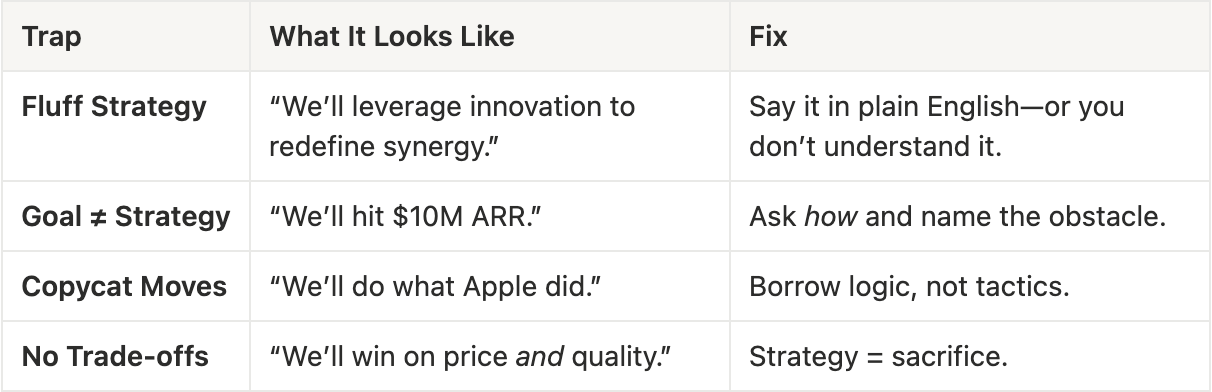
Strategy traps and how to spot them
Here’s what bad strategy looks like:
1. Fluff → Words instead of direction
“We’ll leverage synergies to disrupt the ecosystem.”
2. Goals-as-strategy → Mistaking the scoreboard for the playbook
“Grow revenue 10x this year.” (How? Doesn’t say.)
3. Copycat moves → Chasing someone else’s tactics without their logic
“We need a community like Notion.” (Why? For what purpose?)
4. No trade-offs → Trying to play every game at once
“We’ll be B2B and B2C, premium and freemium, viral and sales-led.”
Bad strategy is long on ambition, short on action. Real strategy takes courage. The courage to choose.
What Good Strategy Looks Like
Good strategy doesn’t kill creativity. It channels it.
Figma’s strategy: “Make design multiplayer.”
That one choice shaped everything: browser-first, real-time collaboration, free tier for viral spread. Even their product videos reinforced one idea: design is better together.
Notion’s strategy: “Build a movement, not just a product.”
So their tactics—templates, community builders, creator pages—all served one goal: empower users to teach other users. They didn’t buy growth. They built an engine that generated it.
Airbnb’s strategy: “Make strangers feel safe staying together.”
Not “scale fast.” Not “disrupt hotels.” Everything—photos, reviews, host profiles, insurance—served that one bet. They didn’t just scale growth. They scaled trust.
Notice the pattern? One clear choice. Every tactic pointing the same direction. No wasted motion.
“Good strategy works by focusing energy and resources on one or a very few pivotal objectives.”
— Richard Rumelt
Start today
Strategy is a practice.
Write your one-sentence strategy
If you can’t write it in one sentence, you don’t have a strategy, you have a wish list.
👉 Formula:
We’ll achieve [objective] by using [strength] against [weakness] in [unexpected way].1
E.g. Figma “We’ll win design tools by making collaboration the default, not an afterthought.”
Make the trade-offs visible
List three things you’ll deliberately not do this quarter. Share why with your team.
Airbnb chose depth over breadth. They built trust mechanisms before scaling to new markets. Strategy without sacrifice is just optimism.
Map Every Tactic to Strategy
Pull up your roadmap. For each initiative, ask: “How does this serve our one-sentence strategy?”
If it doesn’t? Cut it or change it.
Notion didn’t build community for fun. They built it because user-led education was their distribution strategy.
Check for Coherence
Ask: Do our actions reinforce each other, or just coexist on a spreadsheet?
If they don’t build momentum together, your plan is decoration, not design.
Review Monthly
Not to rewrite. To test.
Good strategies evolve as you learn. They don’t drift because someone had a new idea.
The Truth
Good strategy feels uncomfortable. It’s slower to form. It demands more discipline than chaos ever will.
But that discomfort? It’s the sign you’re moving from motion to meaning.
Bad strategy keeps everyone busy.
Good strategy forces everyone to row in the same direction.
One is a treadmill. The other is a compass. One burns energy. The other builds momentum.
Teams that chase every good idea die exhausted.
Teams that commit to one great idea win.
The founders who win aren’t the ones doing the most. They’re the ones doing what matters most, over and over, until it compounds.
So what?
When your strategy is clear, your tactics finally have meaning. You stop chasing noise and start creating signal.
Write your one-sentence strategy today. And see if it still holds tomorrow.
Based on Jonathan Stark